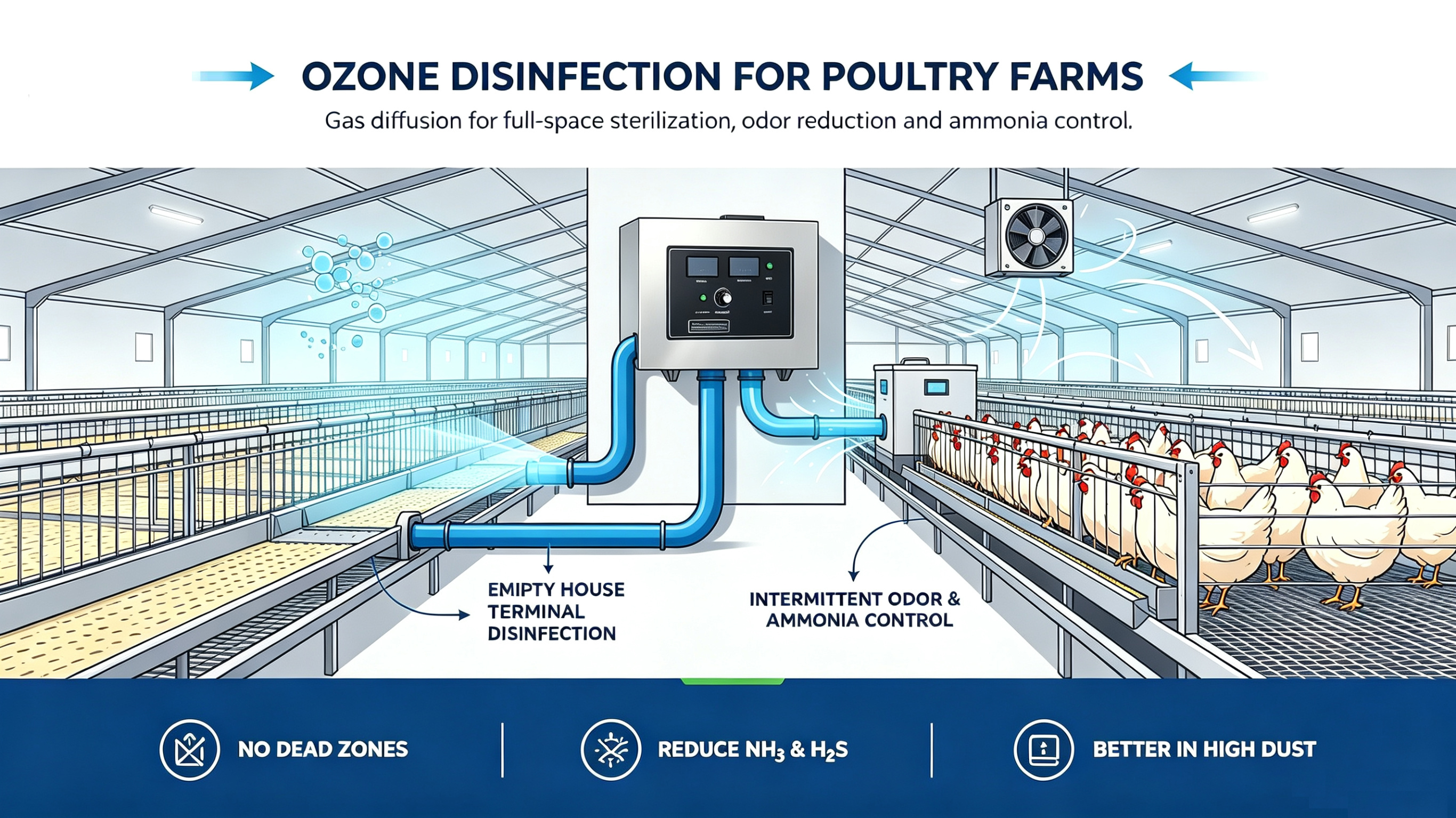
**No disinfection dead spots**
Gas penetrates cage gaps, corners, behind equipment, cracks. Ideal for complex poultry‑house layout. UV fails in shadow zones.
Ozone vs UV‑C Disinfection for Poultry House
One‑Page Brief
Working Principle
- UV‑C: Kills microbes by direct light radiation. Only works on illuminated surfaces; shadows are not disinfected.
- Ozone: Powerful oxidizing gas. Diffuses freely throughout space; treats air and surfaces simultaneously.
Key Advantages of Ozone
- No disinfection dead spots Gas penetrates cage gaps, corners, behind equipment, cracks. Ideal for complex poultry‑house layout. UV fails in shadow zones.
- Sterilize + remove ammonia & odors Ozone oxidizes NH₃, H₂S and manure‑related odors. UV cannot treat harmful gases at all.
- Good performance under high dust & high humidity Dust on UV lamps cuts efficiency by 30‑70% and requires frequent cleaning. Ozone is minimally affected by farm dust and moisture.
- Effective against mold, spores & coccidia oocysts Ozone penetrates thin organic residues. UV is blocked by manure and organic matter.
- Air + surface disinfection in one system One ozone unit treats floating pathogens and all solid surfaces (walls, floors, cages). UV only covers directly‑exposed areas.
- Lower long‑term cost for large volume (e.g.1700 m³ house) UV needs many lamps with annual batch replacement. Ozone has few consumable parts and simple installation.
Strengths of Traditional UV‑C
- No chemical residue; staff can enter immediately after disinfection.
- Instant‑on disinfection.
- Safe continuous air‑treatment during chicken rearing (no direct exposure to birds).
Critical Operating Notes for Ozone
✅ Empty house (no birds): Close doors, run ozone 2‑2.5 h, hold 1 h, then force ventilate ≥3 h before entry. ⚠️ With birds present: Only intermittent low‑duty operation (20 min ON / 60‑90 min OFF) for de‑odorising. Do NOT run high‑concentration ozone with chickens inside, risk of respiratory stress.
| Item |
Ozone Disinfection |
UV‑C Disinfection |
| Coverage |
Gas diffusion, no dead corners |
Line‑of‑sight only, shadow failure |
| Ammonia / Odor |
Oxidize & remove |
No effect |
| Dust‑humidity tolerance |
Stable performance |
Heavy efficiency drop, frequent cleaning |
| Target |
Air + gaps + surfaces; good for mold/spores |
Only directly‑illuminated surfaces |
| Consumables |
Low |
High, regular lamp replacement |
| Empty‑house terminal disinfection |
Excellent |
Moderate |
| Odor reduction |
Excellent |
None |
Conclusion
For poultry farms, ozone is generally stronger than UV-C for terminal disinfection, odor control, and complex housing layouts. UV-C can still play a supporting role, but it cannot replace ozone where full-space coverage and gas removal are needed.
The most practical system combines both: ozone for thorough empty-house disinfection, and UV-C for limited supplementary air treatment during production.