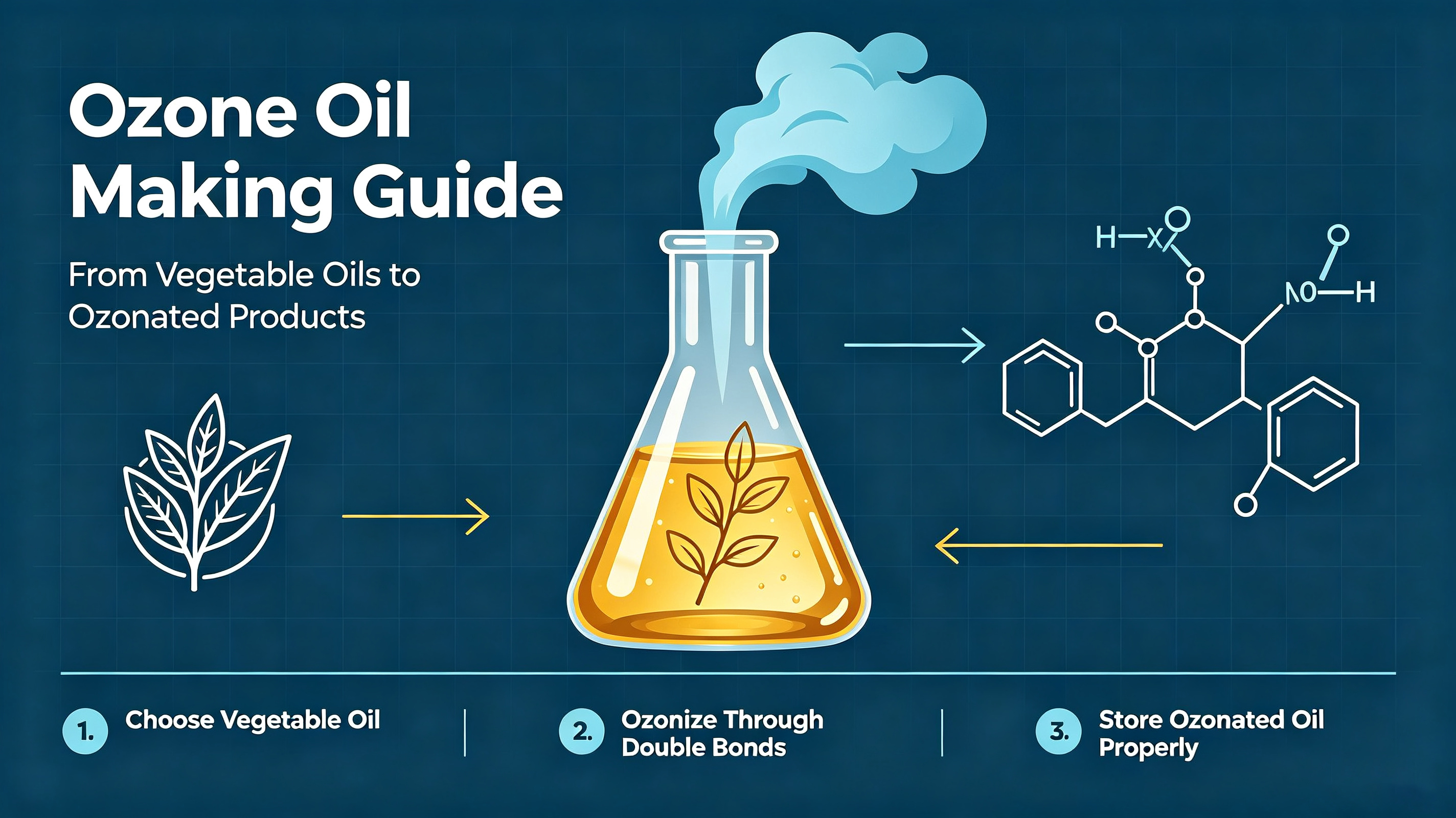
Ozone oil, also known as ozonated oil, is a chemically modified vegetable oil formed when ozone gas reacts with carbon-carbon double bonds in unsaturated fatty acids. The quantity of available double bonds directly determines the reaction potential and final biological activity of the ozonated oil. In this article, we will dive into the fatty acid theory, POI index, raw oil selection, production workflow, quality control and application fundamentals of ozone oil.
Vegetable oils are mainly made up of triglycerides. Depending on their botanical origin, their composition of saturated and unsaturated fatty acids can vary.
Fatty acids are divided into two major categories: Saturated Fatty Acids and Unsaturated Fatty Acids.
All vegetable oils can, in principle, be ozonized. However, the reaction of ozone with vegetable oils occurs through the double bonds of unsaturated fatty acids. Hence the greater the number of available double bonds in the molecule, the greater the number of possible reactions with ozone and also the higher activity of the final product.
Different vegetable oils contain different levels of Omega‑3, Omega‑6 and Omega‑9 fatty acids. We use the Potential Ozonide Index (POI) to evaluate the maximum ozone loading capacity of a vegetable oil.
POI Formula: Omega 3 (×3) + Omega 6 (×2) + Omega 9 (×1) = POI
The higher the POI value, the more ozone the oil can absorb and the higher activity the ozonated oil can achieve
| Vegetable Oil | Omega 3 | Omega 6 | Omega 9 | POI (Strength) |
|---|---|---|---|---|
| Coconut | 0 | 4 | 6 | 14 |
| Castor | 3 | 10 | 6 | 35 |
| Jojoba | 3 | 10 | 10 | 39 |
| Avocado | 0 | 0 | 90 | 90 |
| Olive | 0 | 8 | 76 | 92 |
| Sesame | 1 | 46 | 38 | 130 |
| Sunflower | 0 | 65 | 23 | 153 |
| Hemp | 20 | 60 | 12 | 192 |
Sunflower seed oil delivers outstanding antimicrobial performance among common vegetable oils, largely due to its high polyunsaturated fatty acid content and relatively high POI value. Coconut oil has a low POI, making it suitable for low-intensity ozone oil formulations.
| Vegetable Oil | Saturated (%) | Monounsaturated (%) | Polyunsaturated (%) |
|---|---|---|---|
| Coconut | 92 | 6 | 2 |
| Peanut | 22 | 49 | 29 |
| Cotton | 25 | 24 | 51 |
| Sesame | 19 | 53 | 28 |
| Soy | 15 | 28 | 57 |
| Sunflower | 12 | 20 | 68 |
| Olive | 10 | 84 | 8 |
| Corn | 10 | 36 | 54 |
While the exact equipment and safety setup will vary, the general process follows these stages:
Select raw oil according to your target product activity. For high-activity ozonated oil, choose oils with high POI such as hemp oil or sunflower oil. For mild low-strength products, coconut oil or olive oil can be adopted. Verify oil purity, composition and stability before use. Oils with fragrances, additives or impurities are not suitable for ozonization.
Ozone oil production must be operated with proper safety protection. Ozone gas is toxic when inhaled, so reactions must run inside a fume hood or well-ventilated workspace.
Basic equipment list:
Ozone gas is continuously bubbled into vegetable oil via a diffuser. Ozone molecules react with carbon-carbon double bonds in unsaturated fatty acids to form ozonides.
During ozonization, the oil will gradually change in colour, viscosity and odour. These visual changes only indicate that reaction is underway, and cannot replace POI or chemical testing for quality verification.
Operators continuously monitor ozone flow rate, reaction time, liquid temperature and oil volume.
Insufficient ozone or short reaction time leads to incomplete ozonization. Excessive ozone and overheating trigger over-oxidation, destabilizing the final product.
After reaction completion, residual dissolved ozone and gas bubbles are removed by degassing. Residual ozone must be treated by tail gas destructor before exhaust.
Store ozonated oil in airtight, opaque containers under cool conditions. Keep away from direct sunlight and heat sources. Ozonated oil contains reactive ozonides, treat it as specialty chemical instead of ordinary vegetable oil.
Ozone oil production is not a casual kitchen experiment. Ozone gas is toxic, and the reaction byproducts can be reactive.
If you are new to this process, start with small-scale trials and safety training. Do not scale up production without full risk assessment.
Since the late 1800s, ozonated oils have been explored for topical treatment of many conditions: skin infections, nail fungus, diabetic foot, traumatic lesions, infected wounds, ulcers, burns, dermatitis, vaginal infections, stomatological disorders and more.
Ozonated oil has unique advantages: good stability, long shelf life, high skin tolerance, low surface tension. It is fat-soluble and will not dry rapidly, helping prevent scab and crack formation.
It is applied across multiple fields: periodontal care, stomatology, venous ulcers, digestive health, dermatology, ophthalmology and gynecology.
Important Note: Ozonated oil is not a replacement for prescription medicines. It shall be used under professional guidance for medical-related scenarios.
Ozone oil forms when ozone reacts with carbon-carbon double bonds in unsaturated fatty acids of vegetable oils. The POI index is a practical tool to compare the ozone absorption capacity of different base oils.
High-quality ozonated oil depends on rational oil selection, precise ozone dosing, stable temperature control, proper degassing and suitable storage.
If you plan to produce ozone oil for commercial use, fully understand the fatty acid chemistry, POI calculation, equipment operation and safety protocols first.
Tags: Ozone Oil, Ozonated Oil, Vegetable Oil, POI Potential Ozonide Index, Unsaturated Fatty Acids, Double Bonds, Ozone Generator, Ozonization Process
