Poultry farm biosecurity depends on full coverage, consistent odor control, and resistance to dust and humidity. Traditional UV-C is widely used, but ozone is often a better choice for terminal disinfection and air quality management.
UV-C kills microorganisms by direct radiation. That sounds effective, but it only works where the light reaches. In a poultry house with cages, feeders, drinkers, walls, and organic residues, shadow zones form quickly. Pathogens in those areas may survive.
UV-C also does nothing about ammonia, hydrogen sulfide, or odor. It cannot oxidize harmful gases. In dusty conditions, lamp efficiency can drop sharply, requiring frequent cleaning.
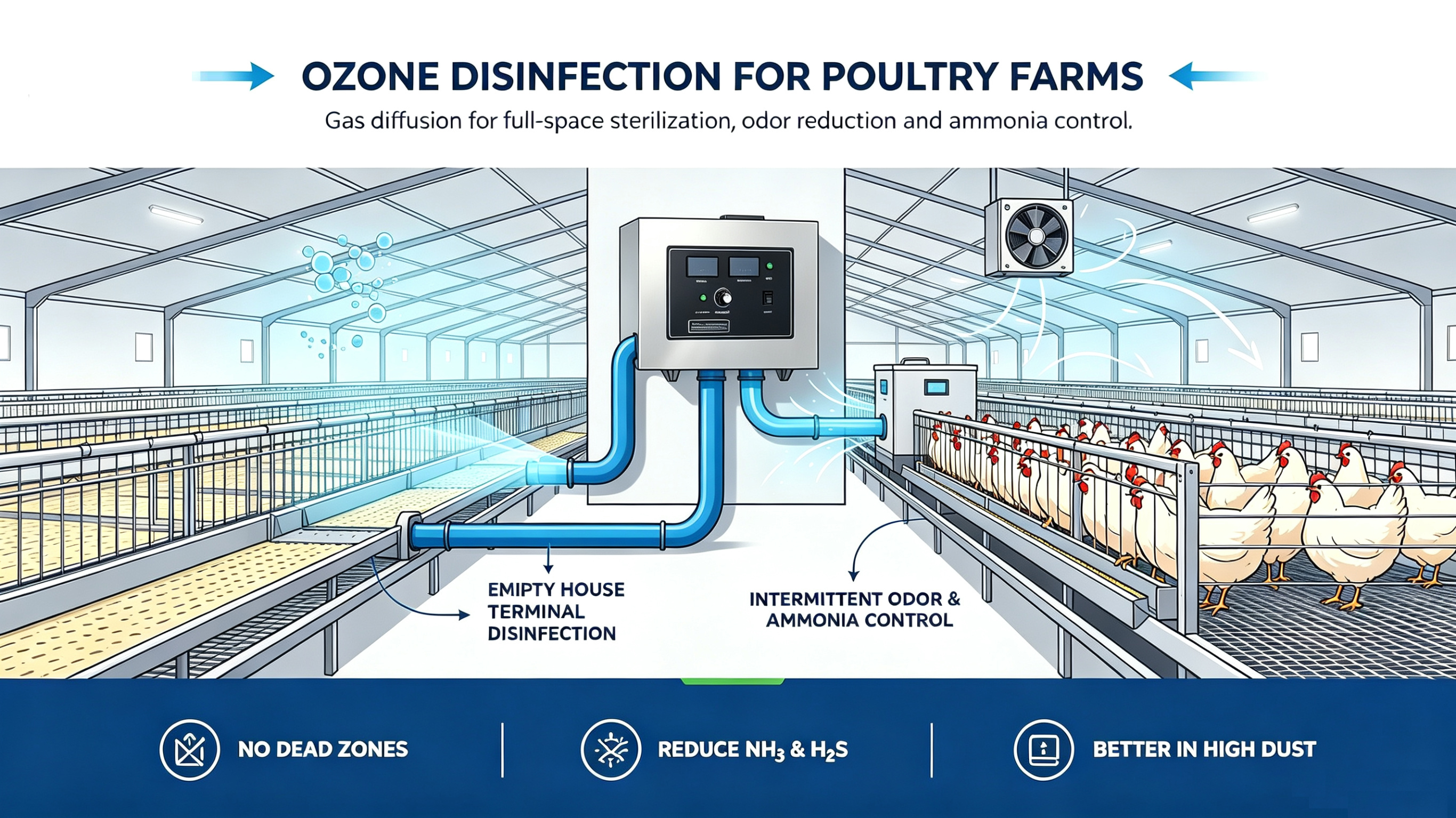
Ozone is a strong oxidizing gas that spreads through the entire poultry house. Unlike UV-C, it reaches cage gaps, wall crevices, equipment backs, floor residues, and other hard-to-access areas. That makes it especially valuable for terminal disinfection between flocks.
Ozone also reduces odor and harmful gases. It can oxidize some ammonia and hydrogen sulfide compounds, improving air quality for both birds and workers. UV-C cannot do this.
Another advantage is stability in difficult conditions. Ozone is less affected by dust and humidity than UV-C lamps, which lose output when covered.
Ozone: empty-house terminal disinfection, mold and spore control, odor and ammonia reduction, hard-to-reach areas.
UV-C: supplementary air treatment in ducts or well-exposed surfaces during production, but only with proper safety controls.
Ozone is powerful and must be controlled.
For poultry farms, ozone is generally stronger than UV-C for terminal disinfection, odor control, and complex housing layouts. UV-C can still play a supporting role, but it cannot replace ozone where full-space coverage and gas removal are needed.
The most practical system combines both: ozone for thorough empty-house disinfection, and UV-C for limited supplementary air treatment during production.
Ozone VS UV‑C Disinfection for Poultry Houses
| Item | Ozone | UV‑C Light |
|---|---|---|
| Working Principle | Strong oxidizing gas, spreads with air | Direct ultraviolet radiation; only works on illuminated surfaces |
| Sterilization Coverage | ✅ Full‑space penetration; reaches gaps, corners, behind cages & equipment; almost no dead zones | ❌ Line‑of‑sight only; shadow areas cannot be disinfected, plenty of dead spots |
| Harmful Gas & Odor Treatment | ✅ Oxidizes ammonia, H₂S, manure‑related odors, improves air quality | ❌ Cannot remove gas or odor at all |
| Performance in High‑dust & Humidity | ✅ Slightly affected, stable performance under farm typical conditions | ❌ Dust covers lamp surface, efficiency drops 30‑70%; needs frequent manual cleaning |
| Target Pathogens | Effective against bacteria, viruses, mold, spores, coccidia oocysts | Good for exposed bacteria & viruses; poor for spores & pathogens hidden under dirt |
| Consumable & Maintenance | Few wearing parts; periodic maintenance for generator & filter | Large‑scale projects need many lamps; regular lamp batch replacement |
| On‑bird Usage | ⚠️ Only low‑concentration intermittent mode for occupied house; high‑concentration strictly for empty house only | ✅ Safe for occupied poultry house (proper installation) |
| Main Drawbacks | Toxic to poultry & human at high concentration; strict safety operation & ventilation required | Cannot solve odor/gas problem; poor effect for complex cage layout |
Ozone excels at empty‑house terminal disinfection and odor‑ammonia reduction for complex poultry‑house layouts, yet requires strict safety management. UV‑C is safe for continuous auxiliary disinfection with birds inside, but limited by shadow dead zones and zero gas‑removal capability.
Recommended practice: Combine both technologies — ozone for thorough disinfection between flocks, UV‑C as supplementary air‑surface treatment during breeding period.

