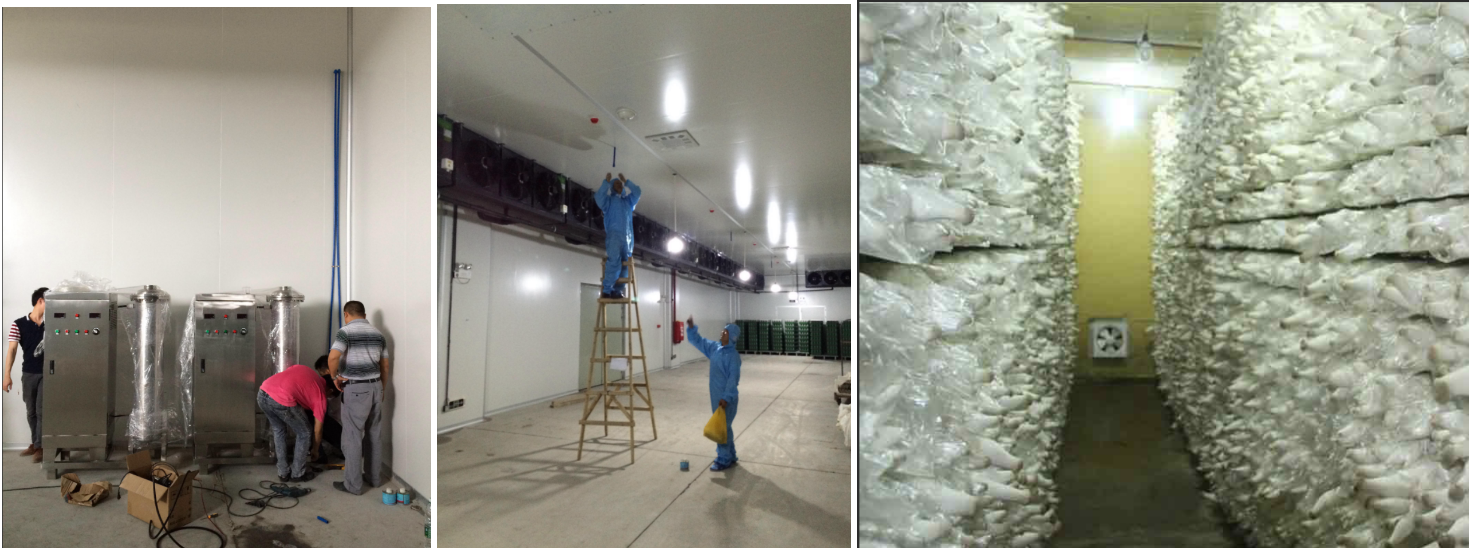
Organic mushroom production demands strict adherence to residue-free and eco-friendly standards, making sterilization a critical challenge. This article explores the application of ozone sterilization in organic mushroom cultivation, covering its working principle, core advantages, practical operation parameters, and applicable scenarios. It explains how ozone sterilization effectively eliminates harmful bacteria, molds, and pests without leaving chemical residues, ensuring the safety and qualit
Case Details
Stage-wise Ozone Concentration & Duration (Critical Safety Thresholds, Over-Prohibition Required)
Stage 1: Empty Mushroom House Disinfection (after cleaning, before feeding substrate, no personnel inside)
Ozone concentration: 10~20 mg/m³ (5~10 ppm)
Single fumigation duration: 40–60 minutes under airtight conditions.
Effect: Eradicate green mold, neurospora, mucor and mite spores with a sterilization rate above 98%. The enclosed sterile environment can be maintained for 7 days after shutdown. Ventilate for 30 minutes post fumigation; ozone will automatically decompose into oxygen, then personnel may enter the mushroom house.
Stage 2: Sterilization in Inoculation Room (before and after inoculation)
Concentration: 15~25 mg/m³, fumigate for 30 minutes to achieve Class 100,000 sterile environment.
Advantages: Replace formaldehyde and aerosol disinfectants with zero residues; the contamination rate during inoculation can be reduced by 50%~65%.
Stage 3: Spawn Run Period (7 days after mycelium colonization, before full colonization of substrate bags)
Ozone must NOT be activated before mycelium germination, otherwise the spawn will be killed. Intermittent bacteriostasis is allowed 7 days after colonization:
Safe concentration: 0.5~1 mg/m³
Operation mode: intermittent operation, run for 5 minutes and pause for 55 minutes per hour; total daily disinfection time ≤ 30 minutes.
Functions: Inhibit miscellaneous bacteria, accelerate mycelial growth by 15%~20%, and cut the contamination rate of substrate bags from 10%~18% down to 0.3%~1.5%.
Stage 4: Fruiting Period (Most vulnerable stage, strict control for infant mushrooms)
- Infant mushroom stage (buds less than 2 cm tall): Ozone concentration ≤ 0.3 mg/m³; only run the ozone generator for 10 minutes in an enclosed space for bacteriostasis after the mushroom house door is opened for access.
- Mature mushroom stage: Concentration ≤ 0.5 mg/m³, intermittent sterilization only at night.
Prohibition: Continuous operation is forbidden during peak fruiting season, otherwise mushroom browning, malformation and premature cap opening will occur.
Stage 5: Ozone Water Treatment (substrate mixing, soaking spawn bags, water replenishment)
Ozone water concentration: 0.5~2 mg/L
Spray ozone water onto culture substrates during mixing: steam sterilization time can be shortened by 30%, preventing high temperature from destroying nutrients in culture medium.
Soak mushroom racks after harvesting in 10 mg/L ozone water for 30 minutes to eliminate residual mold.
4. Ambient Supporting Parameters
Ozone achieves maximum sterilization efficiency when the mushroom house humidity ranges from 80% to 90%; maintain temperature at 16~22°C (optimal growing temperature for mushrooms). The ozone decay coefficient is 0.4208, meaning ozone concentration lasts longer in airtight spaces.
II. Advantages vs. Traditional Disinfection (Formaldehyde / Carbendazim Fumigation)
- Residue-free: Ozone decomposes completely into oxygen within 30 minutes. Mushrooms contain no pesticide residues and qualify as organic edible fungi, commanding a 15%~30% price premium.
- No bacterial resistance: Broad-spectrum sterilization against molds, bacteria and mite spores.
- Labor-saving: No manual preparation of chemicals, fumigation or prolonged ventilation to disperse chemical fumes.
- Optimize air quality inside mushroom houses: Break down carbon dioxide and odors, raise oxygen levels to facilitate mycelial respiration.