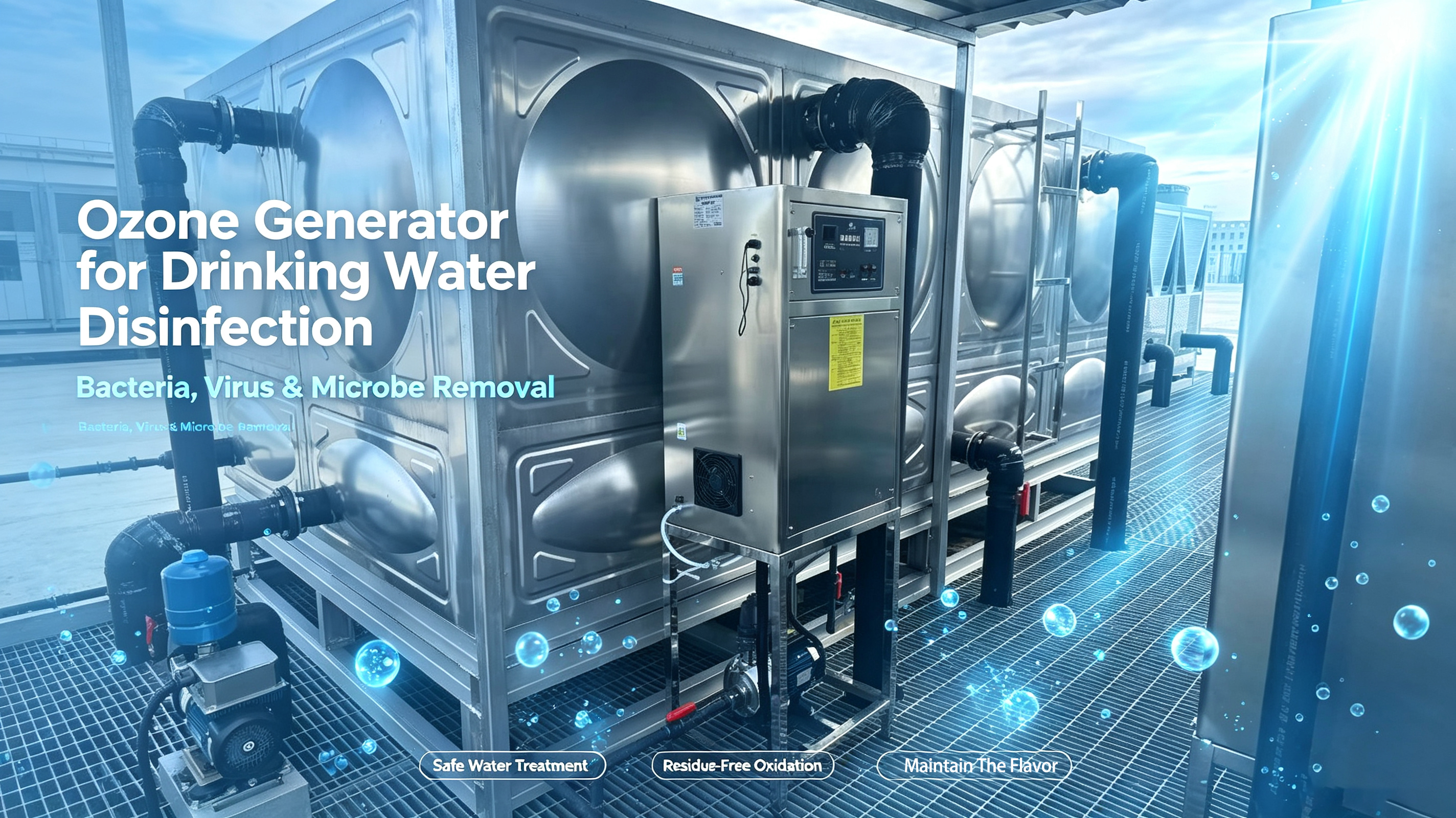
Water quality is the core foundation for drinking water and beverage production. Traditional disinfection methods such as chlorine produce harmful disinfection by-products and affect beverage taste. As a green oxidant, ozone achieves instant sterilization and automatically decomposes into oxygen without residues. It is widely adopted in pure water, mineral water, juice, carbonated drinks and bottled water production lines to ensure water safety and stable product quality.
Application & Technical Data
3.1 Working Principle
Ozone (O₃) is generated on-site by ozone generators. It has strong oxidation capacity that can destroy the cell structure of microorganisms, instantly killing E.coli, legionella, pseudomonas, viruses, spores and algae. After disinfection, ozone decomposes into oxygen within minutes. No chemical residues, no foreign odor, no impact on the flavor of beverages, fully meeting food safety standards.
3.2 Main Application Scenarios & Technical Parameters
Scenario 1: Raw Water / Pretank Water Disinfection
Used for source water treatment before water purification process, remove algae and microorganisms to reduce load of subsequent filtration system.
- Recommended dissolved ozone concentration: 0.3–0.6 mg/L
- Contact reaction time: ≥ 6–10 min
Scenario 2: Finished Pure Water / Drinking Water Sterilization
Terminal disinfection for bottled pure water, mineral water, drinking water stations. Prevent secondary pollution inside storage tanks and pipelines.
- Standard dissolved ozone residual: 0.2–0.4 mg/L
- Contact time ≥ 4 min
Scenario 3: Beverage Production Process Water
Sterilization of mixing water, washing water for bottles and CIP circulating water in beverage factories (juice, energy drinks, tea drinks).
- Ozone dosage: 0.2–0.5 mg/L
- Avoid excessive ozone to prevent oxidation of beverage raw materials
Scenario 4: Water Storage Tank & Pipeline Biofilm Control
Regular circulation disinfection for stainless steel water tanks, delivery pipelines. Eliminate biofilm and prevent microbial reproduction.
- Operation concentration: 0.2–0.4 mg/L
- Periodic treatment: 1–2 times per week
3.3 Standard System Configuration (Match the Picture Equipment)
Ozone Generator → Venturi Mixer / Gas-Liquid Mixing Tank → Stainless Steel Water Storage Tank → Residual Ozone Monitor → Production Water Pipeline
Optional: Tail gas ozone destructor, ORP automatic control system
3.4 Key Technical Guidelines
- Maintain sufficient mixing and reaction time to guarantee sterilization effect;
- Control residual ozone concentration strictly. Excess ozone needs to be removed before filling;
- Install residual ozone monitoring equipment to realize stable automatic operation;
- Ozone cannot be used together with chlorine agents;
- System materials adopt stainless steel 304 / 316L to resist ozone oxidation.
3.5 Target Microorganisms
E. coli, Salmonella, Legionella, Pseudomonas aeruginosa, mold, yeast, protozoa, algae and various waterborne viruses.
4. Economic Benefits Analysis
4.1 Direct Cost Reduction
- Cut chemical disinfection cost: Eliminate continuous purchase of chlorine dioxide, hypochlorite and other disinfectants; reduce annual chemical consumption completely.
- Reduce pipeline maintenance cost: Ozone removes biofilm, avoid frequent pipeline cleaning and blockage.
- Lower wastewater treatment cost: No chemical disinfectant residues, reduce burden of post wastewater treatment.
4.2 Production Value Improvement
- Improve product qualification rate: Stable water disinfection reduces microbial exceeding standard risk, avoid product recall losses.
- Extend beverage shelf life: Effectively inhibit recontamination in finished water, prolong product shelf life.
- Upgrade product competitiveness: Chlorine-free, residue-free water helps brands highlight pure, healthy product positioning, attract more customers.
4.3 Long-Term Operation Advantages
- Ozone is produced on-site from air and electricity; no chemical storage and transportation risks.
- Microbes cannot develop resistance to ozone oxidation effect.
- Main equipment service life: 5–8 years, low daily maintenance cost.
- Fully automatic linkage with water tank system, reduce manual operation.
4.4 Investment Payback Reference
Medium & small drinking water plants: Payback period 12–24 months
Large beverage manufacturing enterprises: Payback period within 10–18 months
5. Conclusion
Ozone disinfection has become the preferred water treatment technology for modern drinking water and beverage factories. Compared with traditional disinfection methods, ozone balances sterilization efficiency, food safety and operating cost. For drinking water plants and beverage manufacturers pursuing high-standard water quality, ozone generator systems are a reliable long-term investment to realize safe and sustainable production.