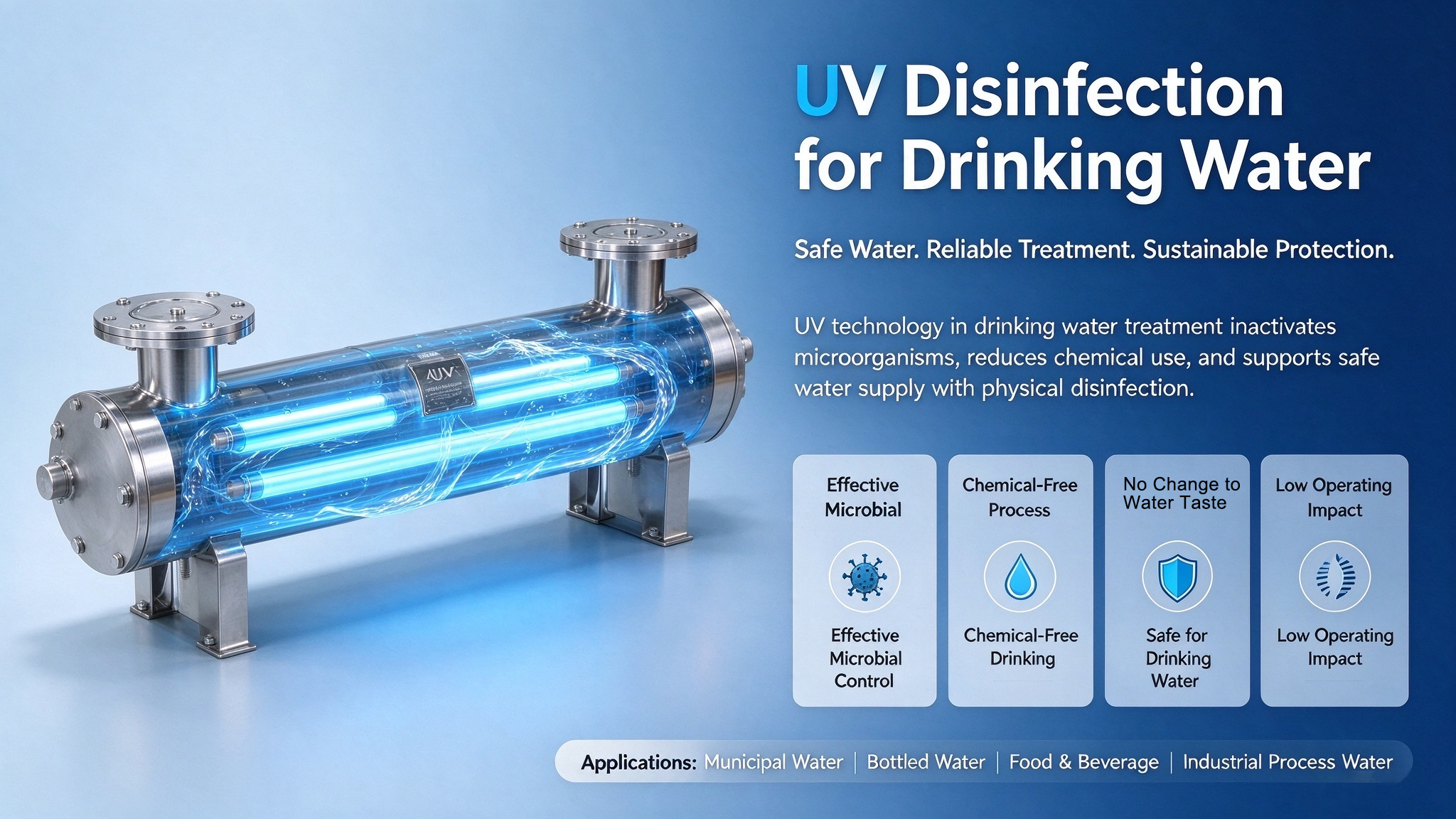
Discover how UV ultraviolet sterilizers work for drinking water disinfection, their main applications, benefits compared to chemical disinfection, and why UV systems are widely adopted in modern water treatment projects.
Safe drinking water is the foundation of public health. Traditional water disinfection methods such as chlorine dosing can effectively kill pathogens, but they bring unavoidable side effects: disinfection by-products, residual chlorine taste, and complicated chemical storage & dosing management. Ultraviolet (UV) disinfection has become a preferred physical water treatment technology for drinking water in recent decades. It uses 254nm UVC ultraviolet light to destroy the DNA and RNA structure of bacteria, viruses and protozoa, stopping microorganisms from reproducing and causing infection. It works instantly as water flows through the UV sterilizer chamber.
✅ No Chemicals, No Disinfection By-Products UV is a purely physical disinfection method. It does not add chlorine, ozone or other chemicals. No THMs or harmful by-products are generated. There is no chlorine odour in finished drinking water.
✅ Fast & Efficient Disinfection Disinfection takes place within seconds when water passes through the UV reactor. It achieves high log reduction of bacteria, E.coli, viruses, giardia and cryptosporidium, which are resistant to chlorine in some cases.
✅ Does Not Alter Water Quality Parameters UV will not change the pH, conductivity, flavour or mineral composition of raw water. It keeps the natural properties of drinking water.
✅ Simple Operation & Low Operating Cost UV sterilizers only consume electricity for UV lamps. No continuous chemical purchase, transportation or dosing equipment maintenance. Modern stainless steel UV units are easy to install inline on pipelines and run automatically.
✅ Safe & Environmentally Friendly There is no risk of chemical leakage, chemical burns or over-dosing. Waste disposal is minimal; only periodic UV lamp and quartz sleeve replacement is required.
✅ Compact Inline Design Pipeline-type UV sterilizers take little space. They can be directly flanged into existing water pipelines for new projects or retrofitting of old water lines.
UV disinfection only works when UV light can reach microorganisms. Turbidity, suspended solids and iron scaling on quartz sleeves will block UVC light and reduce disinfection efficiency.
Best practice: Install UV units after filtration. Regular quartz sleeve cleaning and scheduled lamp replacement are required to maintain stable disinfection performance. UV provides no long-lasting residual disinfection effect in the pipeline, which is different from chlorine.
UV disinfection balances safety, efficiency and sustainability, making it a mature and reliable solution for drinking water treatment. Combined with pre-filtration, it offers clean, chemical-free safe water for residential, commercial and industrial users. As more projects pursue low-carbon and green water treatment, inline UV sterilizers will continue to be a standard choice for modern water disinfection.
UV disinfection is a chemical-free solution for drinking water treatment. It uses UVC light to inactivate bacteria and viruses instantly. ✔ No chlorine & no harmful by-products ✔ Preserves natural water taste ✔ Low running cost, easy inline installation Suitable for well water, tap water, food process water and RO pure water systems.
#UVWaterSterilizer #DrinkingWaterTreatment #WaterDisinfection #WaterTreatmentEquipment


