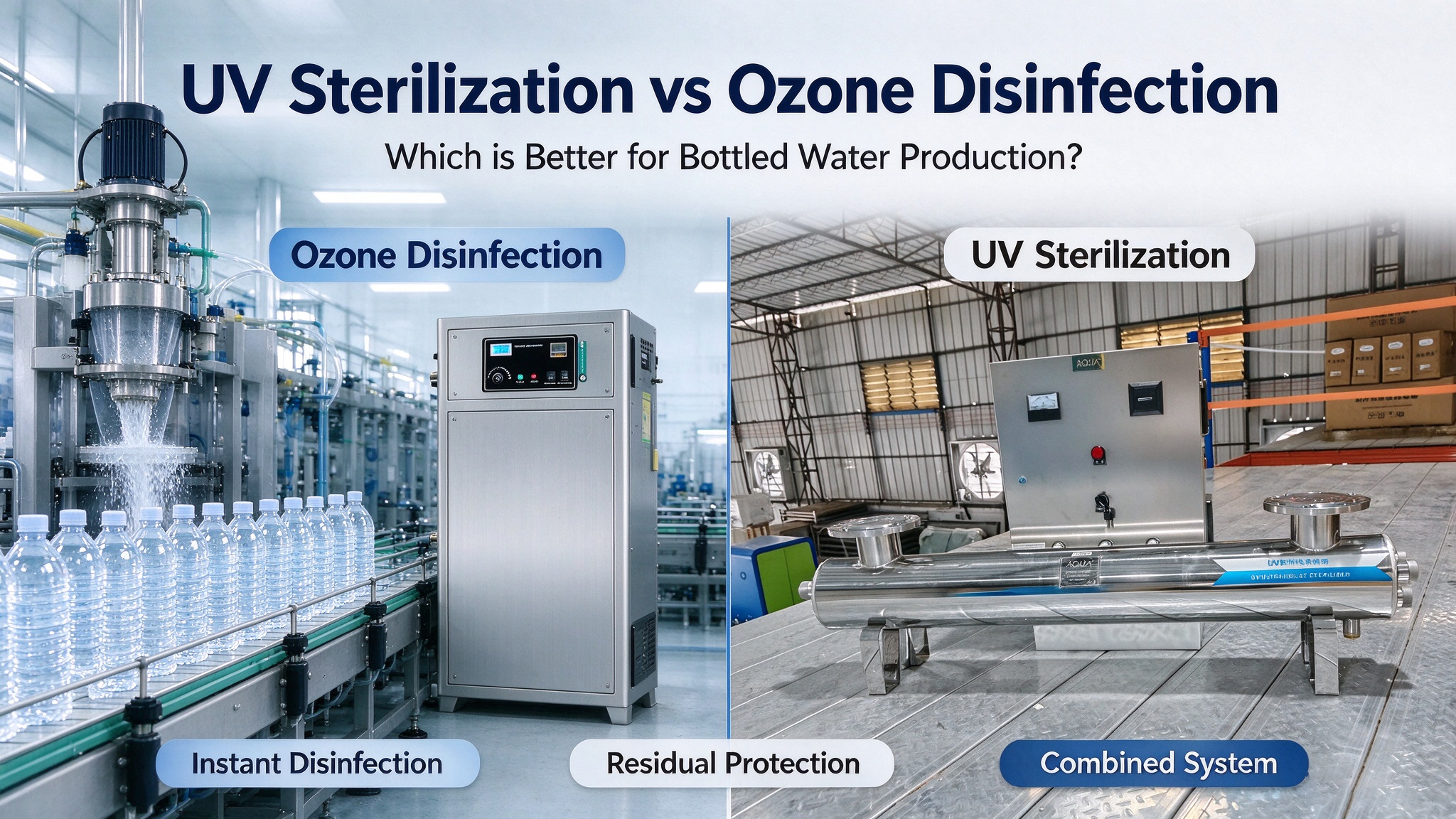
UV Sterilization vs Ozone Disinfection for Drinking Water: What’s The Difference?
For bottled water, drinking water and water treatment plants, choosing the right disinfection technology is critical for product safety, shelf life and operational cost. UV sterilizer and ozone generator are two of the most popular non-chemical water disinfection solutions. Each has unique strengths and suitable application scenarios.
UV Ultraviolet Sterilizer
UV sterilization uses ultraviolet light to damage the DNA of bacteria, viruses and microorganisms, stopping their reproduction instantly.
Advantages
- Instant disinfection effect: Kill microbes immediately when water flows through the UV chamber, no contact time required.
- No chemical by-products: Will not add any substances into water, no taste or odor change for finished drinking water.
- Simple operation & low running cost: Only consume electricity, no chemical consumables. Stainless steel chamber is easy to install inline on water pipeline.
- No residual in water: Disinfection works only when water passes through the UV lamp. No residual disinfectant left in water.
Limitation
UV only works when water is transparent. Turbid water with suspended solids will block UV light and reduce sterilization efficiency. It cannot keep long-term bacteriostatic effect after treatment. It only provides disinfection at the point of treatment, no residual protection for water in storage tanks or bottling pipelines.
Ozone Disinfection (Ozone Generator)
Ozone is a strong oxidant. The oxygen-feed ozone generator produces high-concentration ozone, which mixes with water via venturi injector.
Advantages
- Strong oxidation & wide-spectrum sterilization: Effectively kill bacteria, viruses, spores, and also oxidize organic matter, color and odor in water.
- Residual bacteriostatic protection: Dissolved ozone stays in water for a short period, continuously inhibiting bacteria regrowth in water tanks and bottling lines. Perfect to extend the shelf life of bottled drinking water.
- Works with slightly turbid water: Better performance than UV when raw water contains trace organics.
- Multiple functions: Besides disinfection, ozone can remove iron, manganese and bad smell in raw water.
Limitation
Ozone needs professional mixing system (venturi injector). It will decompose quickly, and improper dosing may cause slight off-flavor. The system needs careful control of ozone concentration.
Quick Comparison & Application Recommendation
- Choose UV sterilizer: If you need point-of-use instant disinfection, keep original water taste, no residual disinfectant. Widely used for RO pure water post-treatment, pipeline terminal sterilization.
- Choose Ozone generator: If you need longer shelf life for bottled water, control bacteria growth during bottling and storage, remove odor and organic pollutants. It is the mainstream solution for bottled drinking water production lines.
Many bottled water factories use UV + ozone combined disinfection system: UV for instant microbial killing, ozone for residual protection in finished water, to achieve stable water quality and longer product shelf life.
Conclusion
There is no absolute “better” technology. Your selection depends on your water quality, final product type and shelf life requirement. For bottled drinking water, ozone is the preferred option for shelf-life control; UV is ideal for point sterilization without changing water flavor. Combining both systems brings the most reliable water disinfection result for water treatment plants.


